Gilded Hollins Community School
R.E. Subject Leadership
Gilded Hollins Primary School
Religious Education
We aim for our children to become knowledgeable in and have empathy for world faiths and cultures. RE is a tool for children to celebrate difference and to prepare them for a happy and successful life in modern Britain.
We have high aspirations for all our children and equip them with values, knowledge and understanding to live and work happily and successfully alongside others.
Intent
Religious Education makes a significant contribution to a child’s spiritual, moral, social and cultural development. The RE curriculum at Gilded Hollins follows the Lancashire Agreed Syllabus for Religious Education, agreed and supported by Wigan Council, published in 2021. Our aim at Gilded Hollins is to work with children so that they understand what others believe, in order to have tolerance and respect of others.
Our teaching of RE is based on an enquiry-based approach to learning. It focuses on improving standards of religious literacy and has an academic rigour that will equip children with the knowledge and skills to engage with religious issues worldwide. Our teaching of RE aims to ensure that our children have a sound knowledge and understanding of a variety of religious traditions and cultures. We give children the opportunities to discuss in detail religious beliefs, moral issues and ultimate questions. They are encouraged to contemplate their own and others’ viewpoints and to practise the skills of listening with empathy and understanding. We aim to prepare children for life in modern Britain, giving them an understanding of events both national and global.
The focus of our teaching is Christianity in line with government guidelines, but we explore the beliefs and practices of other religious traditions represented locally, nationally and globally as we prepare the children to live in a diverse society. Our teaching of RE makes a significant contribution to the development of our literacy skills. It promotes the development of questioning, discussion, critical thinking, reading, writing, reasoning and evaluative skills. Expectations in respect of pupil progress in the National Curriculum with regards to English are reflected in the expectations of pupil progress in the RE curriculum.
Continuity and progression are built into the RE curriculum and the progression grid. The subject knowledge for each unit of work is provided for the children through the use of Knowledge Organisers and these also include key vocabulary. Staff use these as a starting point for their planning and they also inform quizlets which are used to show progress within a topic. Staff plan for activities which will promote curiosity in the children and deep thinking and also encourage them to make connections and reflect on their own thoughts and beliefs.
All classes have the equivalent of 1 hour of RE each week, which may be blocked as appropriate. The RE curriculum is supported by visits and collective worship.
The needs of SEND children are met through various means including the use of differentiated work, the use of support material e.g. word banks, the support of teaching assistants or Kagan structures as appropriate.
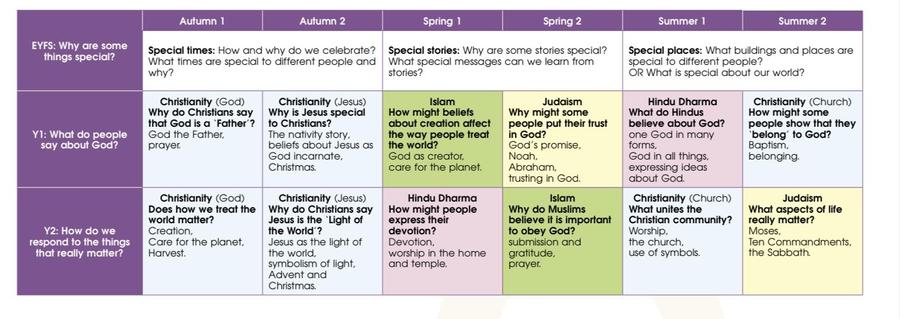
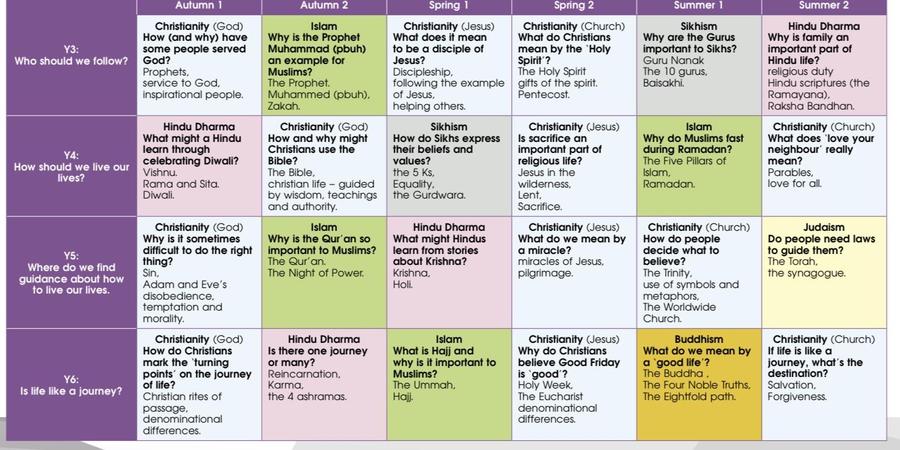
Areas taught across the school
Implementation
The RE curriculum at Gilded Hollins follows the Lancashire Agreed Syllabus for Religious Education, agreed and supported by Wigan Council. Each half term, every year group will cover specific topics through an enquiry based approach in line with the school’s Long Term Plan. Questions such as: Why is Jesus special to Christians? Does how we treat the world matter? and Why do Muslims fast during Ramadan? are explored through a range of activities. The curriculum provides opportunities for discussion and debate which engages and interests the children, making the world of religion come alive. Opportunities are taken to positively promote equality and diversity and to prepare the children for life in modern Britain.
Experiences and enrichment opportunities include:
-
handling artefacts
-
exploring scared texts
-
responding to images, games, stories, art, music and dance
-
using imaginative play or drama to express feelings and ideas
-
meeting visitors from local religious communities
-
making visits to religious places of worship where possible, and where not, making use of videos and the internet
-
taking part in school events (Harvest Festival, Christmas Carol Service, school performances)
-
participating in moments of quiet reflection
-
participating in assemblies
-
using computing to further explore religion and belief globally
-
comparing religions and worldviews through discussion
-
debating and communicating religious belief, worldviews and philosophical ideas and answering and asking ultimate questions posed by these
-
Making links between the curriculum e.g. exploring writing opportunities and using art as a stimulus for embedding knowledge
The skills developed through the teaching of Religious Education include :
-
Questioning - asking relevant questions, to challenge and promote higher order thinking
-
Investigating - investigating world religions, e.g. Judaism, Islam, Christianity- knowing how to gather information from a variety of resources, artefacts. - developing religious vocabulary e.g. to describe key features.
-
Analysing - distinguishing between fact and opinion.
-
Reflection - reflecting on feelings, relationships, beliefs.
-
Empathy - showing consideration for other peoples’ thoughts, experiences and beliefs - developing the ability to show feelings of love, forgiveness and to see the world through other people’s view-points.
-
Expression - explaining religious views and responding to questions.
-
Evaluation - debating issues of religious significance with reference to evidence and argument.
Teachers monitor progress continually and adjust their teaching accordingly. Much of the learning covered in RE is through enquiry and discussion. Assessment through questioning and verbal discussion is an area that the school is working hard to promote and enhance.
Each unit in the syllabus has suggested assessment foci that are used by class teachers to assess the children’s skills and knowledge of each unit covered. In line with a whole school foundation subject assessment, each unit begins with a ‘quizlet’ which shows what the children already know about the subject, checks prior knowledge and allows teachers to plan where to embed knowledge and where to extend. By analysing the results, teachers are then able to personalise learning for both very able, knowledgeable children, as well as supporting those children who have a poorer subject knowledge. The unit then ends with a 'quizlet' to check that children have learnt during the topic and the progress made.
The final results of assessments are stored on INSIGHT, our tracking system and shared with SLT. In this way, children’s progress and achievement in RE can be monitored across the school. Annual results are held by the subject leader file and are used to help inform next steps in the children’s learning in RE.
In the Foundation Stage, learning is initiated from the child’s own knowledge and assessment of children’s knowledge is measured through the steps made in the EYFS profile and is evidenced in the children’s learning journals on Seesaw.
Impact
The children at Gilded Hollins enjoying learning about other faiths and why people choose, or choose not to follow a particular religion. Through their weekly lessons, the children are able to make links between their own lives and those of others in their community and in the wider world. Religious Education therefore acts as a hub between social aspects of learning, science and geography, facilitating opportunities for our children to develop an understanding of other people’s cultures and ways of life, which they are then able to communicate to the wider community.
Religious Education offers our children the means by which to understand how other people choose to live and to understand why they choose to live in that way and as such; this education is invaluable in an ever changing and shrinking world.
What have the children said?
“My favourite story in RE is Blind Men and the Elephant.” - Year 1
“ We learn RE to find out about the beliefs of others and to help us make a choice about which religion we want to follow.” - Year 3
“I have enjoyed learning about the Holy Trinity in Christianity this year.” - Year 5
“I learnt a lot about Hinduism when we visited the Hindu Temple.” - Year 5
Where to now? Recent developments, highlights and priorities for future development 2025-2026
- Continue to build a bank of religious visitors to visit school and support units of work.
JC has worked with staff to enhance the religious visitors that we have in school. In addition to the Ground Breakers Christian workshops that we have once a term, we have also had a Muslim visitor who delivered a workshop to Year 3 about Prophet Muhammad and a whole school assembly about the Five Pillars. We have also had a Jewish visitor who has delivered workshops to Year 2 and Year 5 in addition to a whole school assembly.
- Liaise with RE leadership colleagues to discuss the implementation of a new curriculum in the 2025 / 2026 academic year.
JC has liaised with colleagues following the SACRE scheme and the Lancashire Agreed Syllabus will continue to be followed into at least the next academic year.
- Create a document with suggested school trips for classes to attend throughout the school year to support learning within RE.
JC has created a document to ensure that all classes across school are either attending a school trip or taking part in a workshop within school to support learning within RE. This can be found is the Subject Leader file.
Current standards and progress 2025-26
In Key Stage 1 80% of pupils are working at the expected standard, 20% of pupils are working below the expected standard
In Lower Key Stage 2 81% of pupils are working at the expected standard, 11% of pupils are working above, 8% of pupils are working below the expected standard
.
Next Steps for 2026-2027
- Write and introduce a Collective Worship Policy to provide children with the opportunity to share the experience of worship, develop our community spirit within school, reinforce positive attitudes and promote spiritual, moral, social and cultural education
-Ensure that a consistent style of knowledge organisers including learning objectives, key knowledge and skills and key vocabulary, is being used across school
-As part of Culture Day, ensure staff are teaching children about the religion(s) of the country being taught
-Ensure that a range of physical resources are being used in the teaching of RE, particularly in EYFS and KS1 to support children’s understanding


